Smart contract systems.
Gatekick Labs designs, builds, audits, and secures smart contracts for any on-chain application. DeFi protocols, gaming platforms, token systems, governance, payments, and everything between. Security first, from the first line of code.
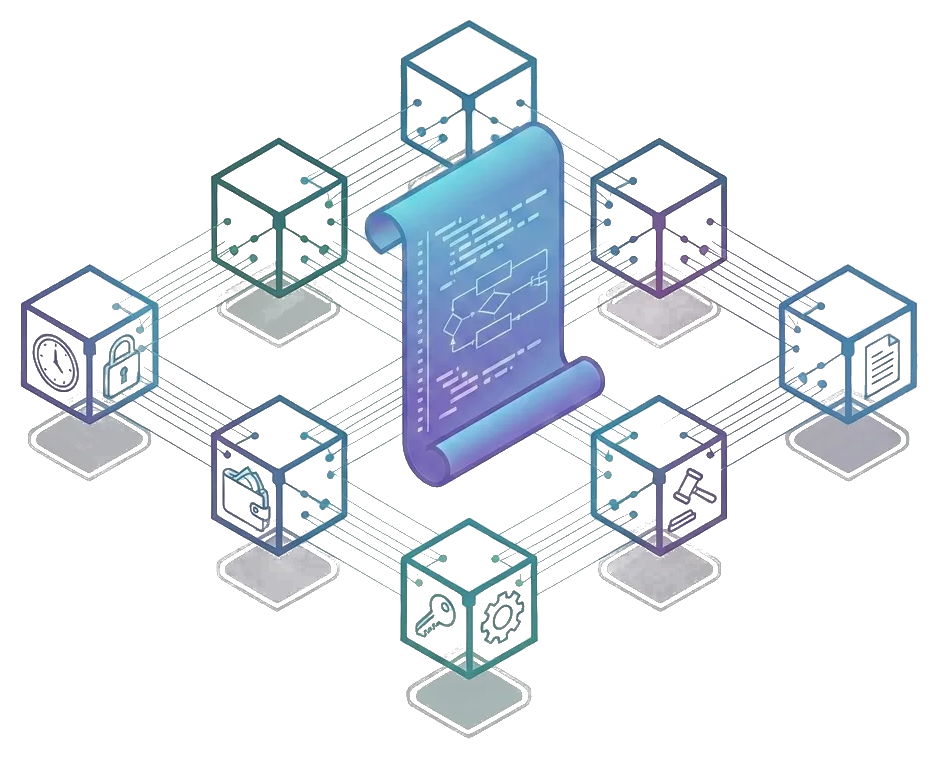
What we build.
Every smart contract we write starts with a threat model, not a template. These are the systems we build most often, and the areas where our experience runs deepest.
DeFi Protocol Contracts
We build the core contract infrastructure for decentralized finance protocols. Automated market makers, lending pools, yield aggregators, and liquidity management systems designed for correctness under adversarial conditions.
- AMM pool contracts with concentrated liquidity support
- Lending and borrowing protocols with dynamic interest rate models
- Yield aggregation vaults with multi strategy routing
- Liquidity bootstrapping and migration contracts
Token Systems
We implement fungible and non fungible token contracts across ERC20, ERC721, ERC1155, and custom standards. Beyond the token itself, we build the vesting, distribution, and access control logic that makes a token actually useful.
- ERC20 tokens with snapshots, permits, and vote delegation
- ERC721 and ERC1155 contracts with on chain metadata
- Vesting schedules with cliff, linear, and milestone unlocks
- Merkle based airdrop and distribution contracts
Gaming and Randomness Contracts
On chain gaming demands provably fair randomness and fast settlement. We build game contracts that integrate Chainlink VRF or commit reveal schemes, handle house wallet management, and settle outcomes in ways players can verify.
- VRF integrated game settlement for dice, roulette, slots, and crash
- Commit reveal randomness for cost sensitive deployments
- House wallet and bankroll management with variance protection
- Multi player session contracts with atomic payout logic
Governance and Voting
We design governance systems that communities can actually use. Governor contracts, delegation mechanics, timelock controllers, and treasury management that balance decentralization against the ability to make decisions and move forward.
- Governor contracts with configurable quorum and voting periods
- Vote delegation with partial delegation support
- Timelock controllers with role based execution
- On chain treasury management with spending limits and approvals
Payment and Settlement
We build payment infrastructure that connects stablecoins and crypto rails to real business logic. Escrow contracts, payment splitting, recurring payment streams, and settlement systems that handle the edge cases of moving money on chain.
- Stablecoin escrow with conditional release and dispute resolution
- Payment splitters with configurable share ratios
- Streaming payment contracts for salaries and subscriptions
- Batch settlement for high volume transaction processing
Cross Chain and Bridge Contracts
We build the on chain components for cross chain communication. Message passing receivers, token bridge endpoints, and multi chain deployment strategies that keep state consistent across networks without introducing unnecessary trust assumptions.
- Bridge endpoint contracts for token locking and minting
- Cross chain message receivers with replay protection
- Multi chain deployment with deterministic addresses
- Chain abstraction layers for unified contract interfaces
NFT and Marketplace Contracts
We build minting infrastructure, royalty enforcement, auction mechanics, and marketplace logic for NFT projects. Not just the token, but the full lifecycle from creation through secondary trading, with on chain royalty compliance where it matters.
- Lazy minting with signature based authorization
- ERC2981 royalties with marketplace enforcement hooks
- English and Dutch auction contracts with reserve prices
- Marketplace listing and offer management with escrow
Staking and Rewards
We build staking pools and reward distribution systems that handle the math correctly. Proportional reward accrual, lockup periods, slashing conditions, and boost mechanics, all designed so the accounting stays accurate at scale over long time horizons.
- Proportional reward distribution using accumulator patterns
- Tiered lockup mechanics with early withdrawal penalties
- Multi token reward pools with configurable emission schedules
- Slashing conditions for validator and delegator staking
Problems we have solved.
These scenarios reflect the types of engagements we take on. The problems vary, but the approach is consistent. Threat model first, then architecture, then code that earns its audit.
Secure custody contracts for a crypto exchange
A mid size crypto exchange needed to move from a centralized hot wallet to a smart contract based custody system with multisig controls, withdrawal limits, and time delayed large transfers. This type of project requires a carefully layered contract architecture with role based access, hardware wallet signing, withdrawal limits, and operational tooling that lets the treasury team manage daily operations safely.
Provably fair game contracts for a gaming platform
A gaming operator launching on chain needed verifiably random outcomes across five game types, with fast settlement and low gas costs. We integrated Chainlink VRF for high stakes games and designed a commit reveal scheme for frequent low stakes plays. The house wallet contract managed bankroll reserves automatically and exposed a real time solvency proof players could verify.
Audited lending pool for a DeFi protocol
A DeFi team building a lending protocol needed contracts that could survive a formal audit without major findings. A project like this requires building the lending pool, interest rate model, liquidation engine, and oracle integration from the ground up. Invariant fuzzing runs against the full system for weeks before the external audit, targeting zero critical findings on first pass.
Tokenized property assets for a real estate company
A real estate firm wanted to fractionalize commercial property ownership into tradeable on chain tokens with compliant transfer restrictions. The solution uses an ERC1155 based system where each property is a distinct token ID, with transfer hooks enforcing KYC status, holding limits, and jurisdiction restrictions. Dividend distribution runs on chain through a proportional reward contract.
Governance and treasury for a DAO
A protocol DAO needed governance contracts that its community would actually use, not a system so complex that proposals never reached quorum. The solution requires a Governor contract with tuned quorum thresholds, a delegation system that makes voting accessible to passive holders, a timelock for execution safety, and a treasury contract with spending tiers matched to the DAO's operational needs.
How we approach every contract.
Smart contracts are safety critical software. A bug does not produce an error message. It produces a loss of funds. Our process reflects that reality at every stage.
Discovery and Threat Modeling
We start by understanding who can call which function, under what conditions, and what the worst case outcome looks like for each path. We map out actors, attack surfaces, and economic incentives before writing any code. This threat model becomes the foundation document that every design decision references.
We also identify external dependencies early. Oracles, bridges, third party contracts, and off chain systems all introduce trust assumptions. We document each one and decide how the contract should behave when a dependency fails or returns unexpected data.
Architecture and Design
We define the contract's state machine explicitly. What states can it exist in, what transitions are valid, and what invariants must hold at all times. We choose upgrade patterns based on actual requirements, not convention. If a contract does not need upgradeability, it does not get a proxy. If it does, we pick the simplest pattern that satisfies the need.
Access control roles, function visibility, and admin capabilities are designed at this stage. We favour small surface areas. Every public function is a potential attack vector, so we only expose what is strictly necessary.
Implementation and Testing
We write the contract against the threat model, not against a feature checklist. Unit tests run from the first function. Integration tests cover multi contract interactions. We maintain a running list of assumptions and write tests that verify the contract fails loudly and safely when those assumptions are violated.
Gas optimization happens here, but never at the expense of clarity. A contract that costs ten percent less to execute but is twice as hard to reason about is a bad trade. We document every non obvious choice so the team that inherits the code never has to guess.
Security Review and Hardening
We run static analysis with Slither, symbolic execution with Mythril, and invariant fuzzing with Echidna as part of the normal development loop. Property based tests verify that critical invariants hold across thousands of randomized inputs. If a pattern is too clever to explain in a paragraph, we rewrite it.
We also think about the operational picture. Multisig configurations, pause mechanisms, emergency withdrawal paths, and incident playbooks. Good contracts fail gracefully, and graceful failure is a team discipline as much as a code discipline.
Audit Coordination
External audits are planned into the timeline from the beginning, not bolted on at the end. We prepare the codebase with comprehensive NatSpec documentation, architecture diagrams, and a list of known assumptions and areas of concern. When auditors receive the code, they spend their time on deep analysis, not orientation.
We help triage findings by severity and coordinate fixes. By the time code reaches an external auditor, our internal review has already caught the common issues. The audit becomes a confirmation pass rather than a discovery pass.
Deployment and Monitoring
We deploy through deterministic scripts that produce the same result on every run. Constructor arguments, proxy initialization, and role assignments are all scripted and version controlled. Nothing is configured by hand. Post deployment, we verify source code on block explorers and confirm that the on chain bytecode matches the audited source.
We set up monitoring for critical contract events, balance thresholds, and unusual transaction patterns. If something unexpected happens at two in the morning, the team knows about it and has a playbook for responding.
Security is a discipline, not a checkbox.
A smart contract bug can mean immediate, irreversible loss of user funds. There is no rollback, no hotfix, and no customer support escalation. Our security methodology reflects the weight of that reality.
Threat Modeling Framework
Every engagement begins with a structured threat model. We identify actors (users, admins, attackers, bots), map their capabilities, define what they should and should not be able to do, and enumerate the economic incentives that might motivate an exploit. The threat model is a living document that evolves as the contract design evolves.
We pay particular attention to composability risks. A contract that is secure in isolation may become vulnerable when composed with other protocols, flash loan providers, or MEV bots. We model these interactions explicitly.
Vulnerability Classes We Check
We systematically review for known vulnerability patterns across every contract we build.
- Reentrancy via external calls and cross function reentrancy
- Access control gaps, missing modifiers, and privilege escalation
- Front running and sandwich attack exposure
- Oracle manipulation through price feed or TWAP exploits
- Flash loan attacks that exploit single transaction composability
- Integer overflow and precision loss in financial calculations
- Denial of service through gas griefing or unbounded loops
- Storage collision in upgradeable proxy patterns
Testing Methodology
We layer multiple testing strategies because no single approach catches everything.
- Unit tests for individual function correctness and edge cases
- Integration tests for multi contract interaction flows
- Property based testing to verify invariants hold across random inputs
- Invariant fuzzing with Echidna to explore state spaces humans miss
- Fork testing against live mainnet state for realistic conditions
- Gas snapshot tests to catch unexpected cost regressions
Formal Verification
For high value contracts where the cost of failure justifies the investment, we apply formal verification using Certora Prover. Formal verification mathematically proves that specified properties hold across all possible inputs, not just the inputs we thought to test. We use it to verify critical invariants like "total supply always equals sum of all balances" or "no user can withdraw more than their deposited amount."
Formal verification is not a replacement for testing or audits. It is an additional layer of assurance for the properties that matter most. We recommend it selectively, for the contracts and invariants where the stakes justify the effort.
Audits that confirm, not discover.
External audits are essential. But an audit should validate your security posture, not be the first time anyone looks at the code critically. We prepare so thoroughly that auditors can focus on the hard problems.
Early Planning
We schedule audits at the beginning of a project, not the end. Audit firms have multi week lead times and queues that can stretch for months. We book audit slots early and design the development timeline so code is audit ready when the window opens. This prevents the common failure mode where an audit becomes the last minute bottleneck before launch.
Code Preparation
Before code reaches an auditor, we prepare a complete package. NatSpec documentation on every public function. Architecture diagrams showing contract relationships and data flows. A document listing known assumptions, areas of concern, and design decisions that need scrutiny. The goal is to let auditors spend their hours on deep analysis, not figuring out what the code is supposed to do.
Findings Triage
Auditors will find issues. Some are critical vulnerabilities that must be fixed before deployment. Some are medium severity concerns worth addressing. Some are informational suggestions or gas optimizations. We help you assess each finding, understand its real world impact, and prioritize fixes based on risk rather than treating every finding with equal urgency.
Recommended Audit Partners
We work with and recommend established audit firms based on the specific technology and domain. For EVM contracts, firms like Trail of Bits, OpenZeppelin, Consensys Diligence, and Spearbit are strong options depending on scope. For Solana programs, OtterSec and Neodyme specialize in Rust based audits. We help you choose the right firm for your protocol's needs and budget.
Tools we use daily.
We choose tools based on the problem, not habit. These are the languages, frameworks, and security tooling we work with across our smart contract engagements.
EVM Development
Solidity is our primary language for EVM chains. We use both Hardhat and Foundry depending on project needs. Hardhat for teams that prefer JavaScript tooling and plugin ecosystems. Foundry for projects that benefit from fast Solidity native testing and fuzzing.
Solana Development
For Solana programs, we write in Rust using the Anchor framework. Anchor provides the structure and safety checks that make Solana development less error prone, while still allowing low level optimization where performance demands it.
Standards and Libraries
We build on established, audited libraries rather than rewriting standard functionality. OpenZeppelin contracts provide battle tested implementations for access control, token standards, and common patterns. We extend them when needed but avoid unnecessary customization of code that has already survived years of production use.
Security and Analysis
Security tooling runs continuously during development, not as a final check. Static analysis catches common patterns. Symbolic execution explores paths humans overlook. Fuzzing discovers edge cases that unit tests miss. Formal verification proves critical invariants mathematically.
Adjacent work we do.
Tokens & tokenization
The standards, extensions, and distribution logic that sit on top of the contracts we build.
Verifiable data & proofs
Merkle proofs, attestations, and zero knowledge systems wired into the contracts that rely on them.
Governance & treasury
On chain voting, timelocks, and the access control that decides who can change the code.
Tell us what your contracts need to survive.
A short description of the system, the chain, and the threats you care about is enough for us to say whether we can help.